
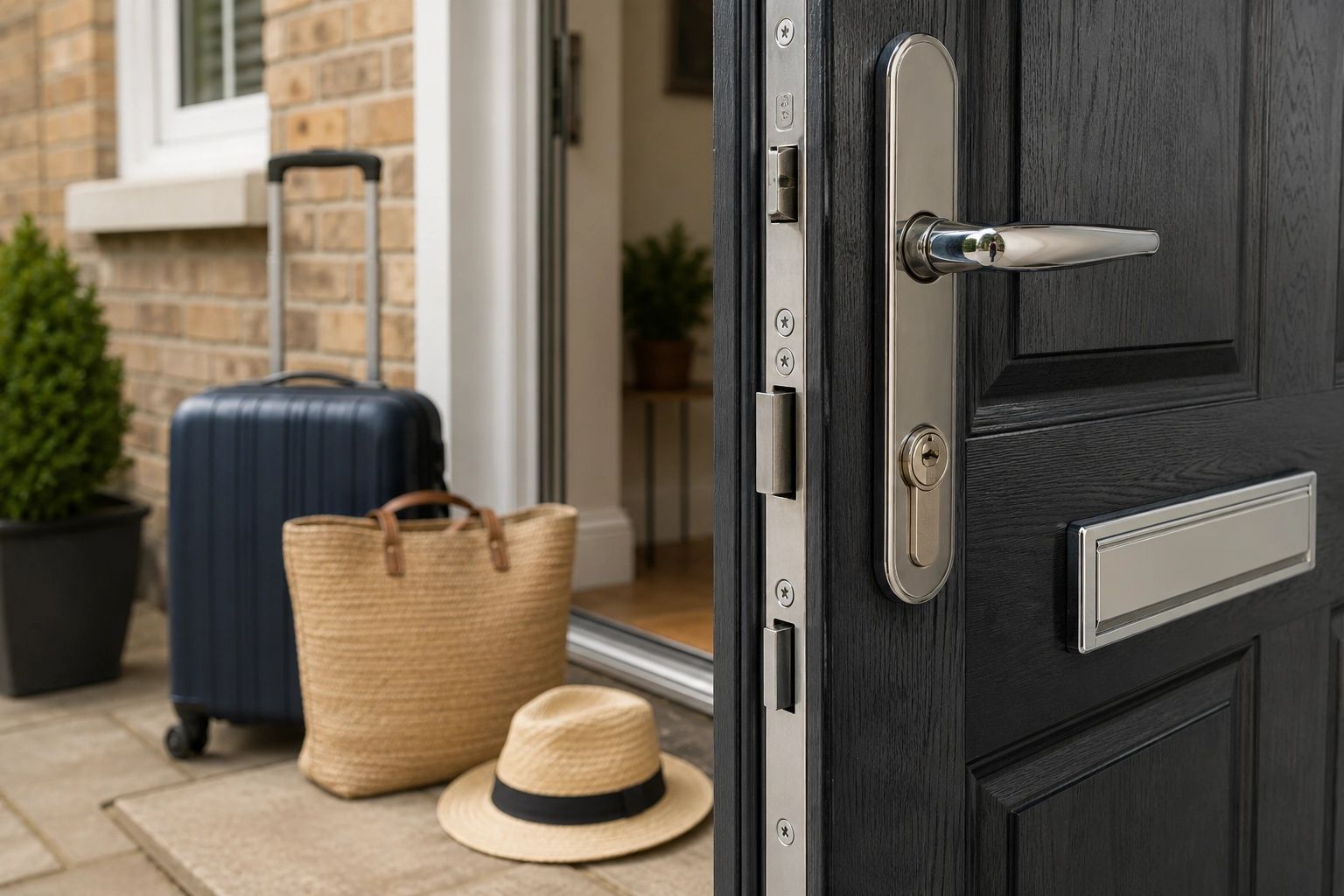
Every summer, the same pattern repeats across the UK. Families pack the car, lock the door out of habit, and head off for a week or two, while their home sits empty and, in many cases, more vulnerable than they realise. Door hardware is rarely the first thing on a pre-holiday checklist, yet it is consistently the first thing a burglar will test. At Door Handle Company, we hear from customers every summer who are looking to sort out a loose lock or a tired letterbox before they go away, and a few small checks now can save a great deal of stress later.
This guide walks through the door-related checks worth making before you leave, along with the standards to look for if any of your hardware needs replacing rather than just tightening.
Checking your external locks
The most basic, and most overlooked, step is simply testing every external door lock manually rather than assuming it works because it always has. Locks that have become stiff, slow to turn, or that need a firm shove to engage are showing early signs of wear, and wear is exactly what makes a lock easier to defeat. Front doors get the most attention, but side doors, utility doors and any access point to a garage or outbuilding deserve the same check.
Insurance providers commonly look for door locks that meet BS 3621, the British Standard covering thief-resistant locks for doors. A lock that meets this standard typically requires a key to operate from both sides, which prevents an intruder from simply reaching through a broken pane of glass and turning a thumbturn. If you are not sure whether your current locks meet this standard, it is worth checking before you travel rather than after a claim.
Patio and French doors: an easy point to forget
Patio and French doors are frequently left on a single-point lock, particularly on older installations, which makes them a comparatively easy target. An espagnolette handle secures the door at multiple points along its length with a single turn, offering a meaningful upgrade over a basic single-point catch. If your patio doors have not been checked in a few years, this is a sensible place to start.
It is also worth remembering that doors left ajar for ventilation during a heatwave are easy to forget about entirely once the packing begins. A final walk-through of every external door and window, on the morning you leave rather than the night before, catches the ones that get left open in the rush.
Letterboxes and fishing attacks
A letterbox is a small but genuine weak point. Older or oversized letter plates can allow a hand or a hooked tool to reach through and access keys left near the door. A modern telescopic letter plate, sized and guarded correctly, closes this gap. Products certified to TS008, the British Standard for letterbox security, are independently tested against this specific risk and are increasingly specified by insurers for higher-risk properties.
If your current letter plate is older than your locks, it is worth checking at the same time. Replacing a letter plate is a straightforward job for most competent DIYers, and does not require specialist tools.
A short checklist before you lock up
Test every external door lock by hand, not just by sight. Check patio and French doors specifically, since these are commonly the weakest point. Confirm your letterbox cannot be reached from outside and consider a TS008 certified plate if it is original to the property. Check sheds, garages and any outbuildings holding tools or bicycles. None of these take long, and all of them are easier to sort the week before you travel than the week you get back.
Use case: a quick pre-holiday upgrade
A customer contacting us in early July described a familiar situation: patio doors original to a 1990s extension, a single-point lock that had become increasingly stiff, and a holiday booked for the following week. A same-week upgrade to a locking espagnolette handle, paired with a check of the front door cylinder, resolved both issues before departure, at a modest cost relative to the peace of mind it provided.
A pre-holiday door check costs very little time and even less money, particularly set against the cost and disruption of dealing with a break-in while you are away. Locks, latches and letterboxes are simple to check and, where needed, simple to replace.