
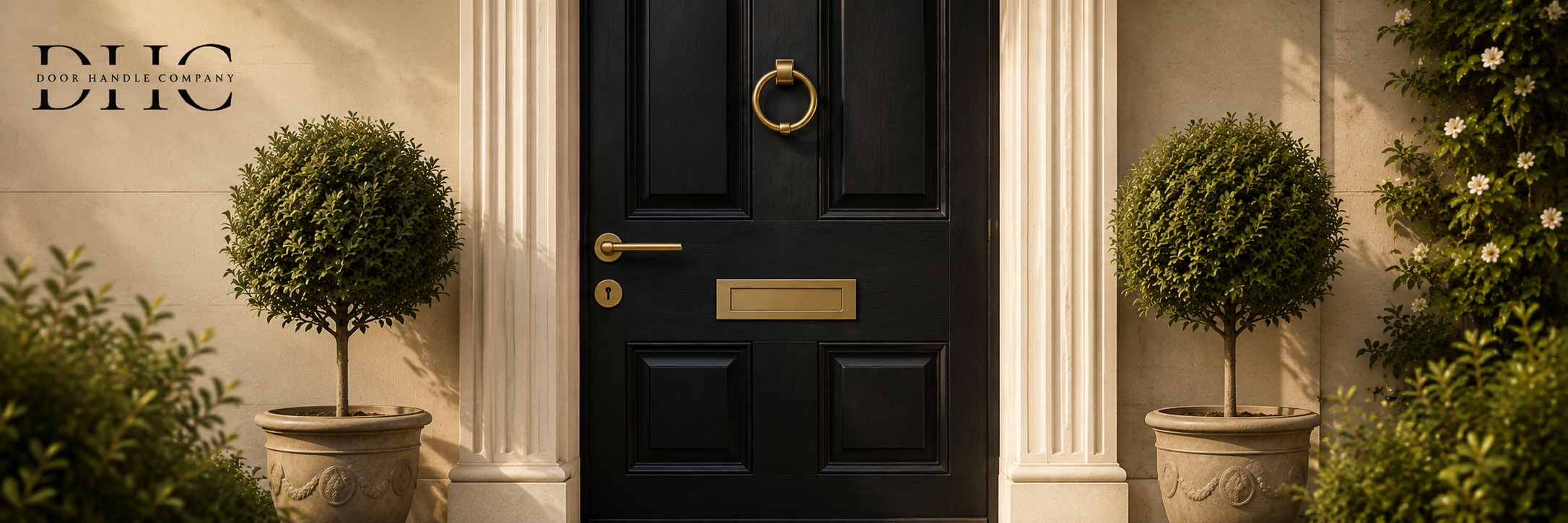
Updating the hardware on your front door is one of the most impactful things you can do for your home’s exterior. A well chosen set of external door hardware, with everything in the same finish and style, transforms a front door from something functional into something that genuinely makes an impression.
But if you have never bought external door hardware before, the number of options can feel overwhelming. Lever handles, pull handles, letter plates, knockers, escutcheons, cylinder covers. What do you actually need, and how do you choose?
This guide covers everything you need to know.
External Door Handles vs Entrance Pull Handles
The most important distinction to understand before you buy any external door hardware is the difference between an external door handle and an entrance pull handle.
An external door handle is an operational handle. It connects to your door’s latch or lock mechanism and allows you to open the door from the outside. These are available in several configurations: on a backplate (a larger escutcheon plate that covers the lock mechanism), on a rose (a smaller circular plate), or as part of a door pack that includes a matching interior handle and the necessary fixings.
An entrance pull handle is a fixed, non operational handle. It does not move the latch. Instead, it is used to pull the door open after you have released the lock with a key or thumb turn. Pull handles are popular on heavier hardwood or composite front doors and give a bold, architectural quality to an entrance. They are also commonly used on commercial and office buildings.
The right choice depends on your door type, your lock setup, and the look you are going for. If you are replacing a handle that previously operated your lock, you need an external door handle. If you are adding a separate pull to a door that has a separate lock mechanism, an entrance pull handle may be the better option.
Letter Plates
A letter plate is the hinged slot through which your post is delivered. It sounds simple, but there is more variation in external door letter plates than most people expect.
Orientation: most letter plates are horizontal, but vertical letter plates are available and can be the right choice where a door stile is too narrow for a standard horizontal fit.
Spring tension: letter plates can be sprung (the flap returns to a closed position automatically) or unsprung. Sprung letter plates do a better job of keeping out draughts and are the more practical choice for most homes.
Inner letter tidies: a letter tidy fits on the interior side of the door and catches post as it comes through, preventing it from falling to the floor. It also provides an additional layer of draught proofing.
Size: standard letter plates fit most front doors, but if your door has a narrow stile or a fixed slot position, check the dimensions carefully before purchasing. The fixing centres need to match your existing hole positions if you are replacing an existing letter plate.
Door Knockers
If your property does not have a doorbell, or if you simply prefer the traditional feel, a door knocker is a worthwhile addition to your external door hardware. It is also one of the most visible pieces of hardware on a front door and contributes significantly to the overall impression.
Door knockers are available in a wide range of styles. Ring knockers are the most traditional and work well on Georgian and Victorian properties. Lion head and fox head knockers add a decorative quality that suits period homes particularly well. More restrained, architectural knockers are available for contemporary properties.
As with all external door hardware, the finish is critical. A knocker in polished brass on a door fitted with matt black hardware will look out of place regardless of how good each individual piece is. Match the finish across all external hardware for a coherent result.
Escutcheons and Keyhole Covers
An escutcheon is the decorative plate that surrounds a keyhole. It is a small piece of external door hardware, but it is one that is immediately noticeable if it is missing, damaged, or a different finish to everything else on the door.
If your door has a visible keyhole, make sure your escutcheon is included in your hardware order and that the finish matches your handle, letter plate, and knocker. A full matched set will always look more considered than a door assembled from parts bought at different times.
The Finishing Details: Numerals, Bell Pushes and Cylinder Covers
These are the pieces of external door hardware that are easiest to overlook and that most frequently let an otherwise well finished door down.
House numbers and letters: available in a range of sizes and finishes. Ideally these should match the finish of your main external hardware. A polished brass number on a matt black door will look like an afterthought.
Bell pushes: if you have a doorbell, the push button is visible on the face of your door. A bell push in a matching finish is a small detail that contributes to a more complete overall appearance.
Cylinder covers and cylinder pulls: if your door has a euro cylinder lock, a cylinder cover or pull can improve both the appearance and the security of the lock by protecting the cylinder from attack. Again, match the finish to your other external hardware.
Choosing the Right Finish for Your External Door Hardware
The choice of finish is as important as the choice of product type. The most common finishes for external door hardware are:
Polished brass: traditional, warm, and classic. Works well on Georgian and Victorian properties. Requires occasional cleaning to maintain its shine.
Satin brass: a quieter, less reflective take on brass. Suits period properties where polished brass might feel too formal, and has seen a significant revival in recent years.
Antique brass: a darker, aged appearance. Works particularly well on period and rural properties.
Polished chrome: clean and bright. Suits contemporary and mid century modern properties.
Satin chrome: a softer version of polished chrome. More forgiving in terms of fingerprints and marks.
Matt black: bold, contemporary, and increasingly popular. Works well on both modern new builds and period properties where a contrast finish is desired.
Black antique: a traditional finish with a darker, aged quality. Similar to antique brass in feel but darker in tone.
As a rule, choose one finish and apply it consistently across all external door hardware. Mixing finishes can work if done deliberately and with care, but it is difficult to execute well and rarely worth the risk.
Choosing the Right Finish for Your External Door Hardware
If you are updating your external door hardware and are not sure where to begin, start with the handle or pull handle. This is the most prominent piece and will set the direction for everything else. Once you have chosen a handle and a finish, the remaining pieces, letter plate, knocker, escutcheon, numerals, bell push, follow naturally.
Browse our full range of external door furniture to find the right combination for your home. If you need help, our team is on hand to offer advice.