
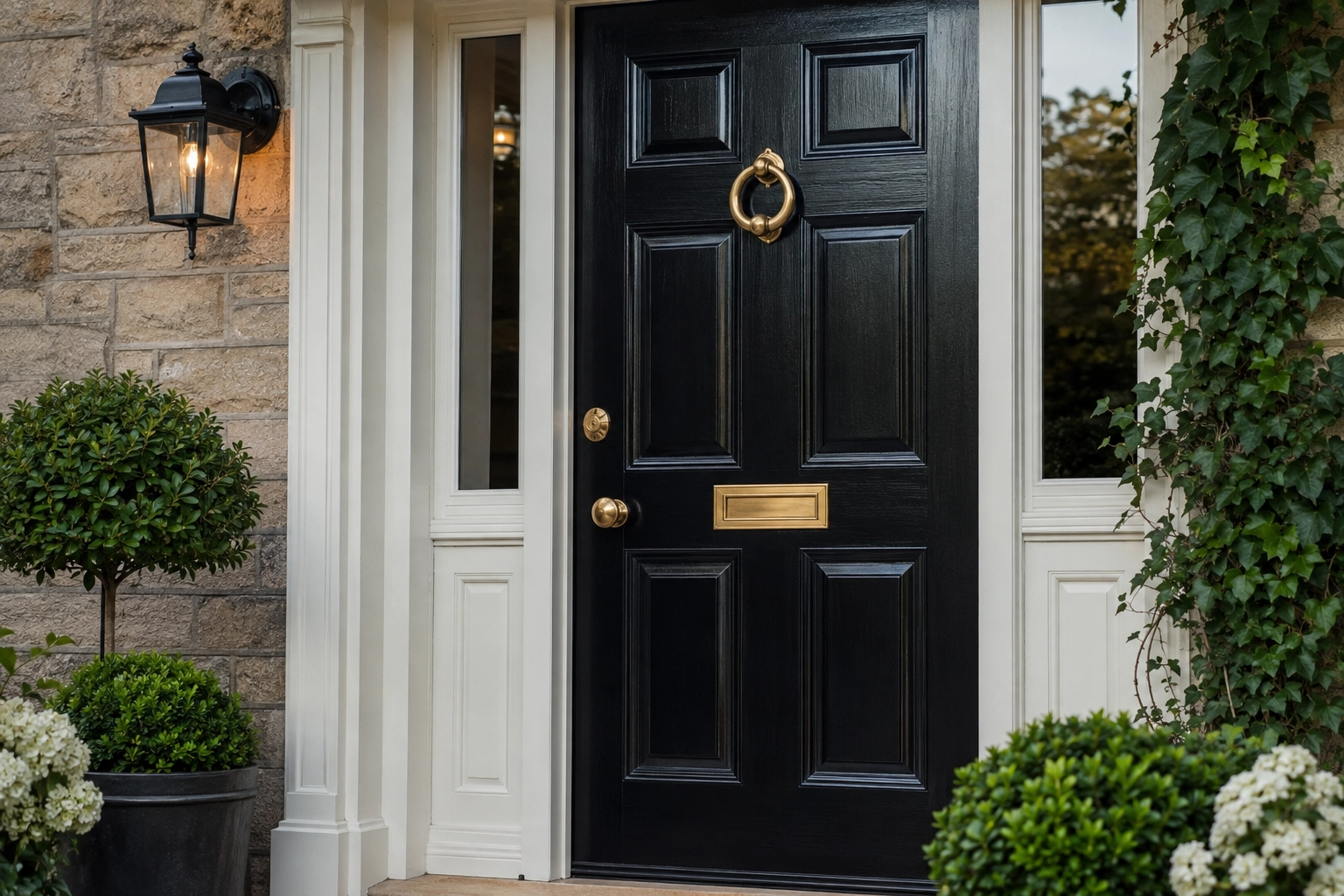
The hardware on your front door is easy to overlook. It is simply there, functional, familiar, and largely taken for granted. But look a little closer and you will find that the external door hardware on our homes carries centuries of history, shifting tastes, and changing ideas about what a home should say to the world.
Wrought Iron and the Age of Utility
For most of human history, external door hardware existed for one reason: to keep a door shut. In medieval Britain, wrought iron was the dominant material. Handles and hinges were forged by hand in local smithies, heavy and unadorned. There was no consideration of style. A door handle was a lever, nothing more.
This began to change as towns grew and trade routes expanded. Greater prosperity meant greater attention to appearances, and the front door was the most visible surface of any property.
The Georgian Era: Brass and the Birth of Kerb Appeal
The 18th century transformed the front door entirely. As the merchant classes accumulated wealth, the entrance to a home became a measure of its owner’s standing. Brass emerged as the material of choice for external door hardware. Warm, lustrous, and unmistakably prosperous. Polished brass door knockers, escutcheons, and lever handles became the norm for any household with aspirations.
This was also the period in which the letter plate arrived. The expansion of postal services in the late 18th and early 19th centuries created a practical demand that quickly became a design opportunity. The Georgian letter plate, often with a polished brass flap and clean lines, remains one of the most enduring front door details to this day.
Victorian Refinement and the Rise of Mass Manufacturing
The Victorians inherited Georgian elegance and industrialised it. Mass manufacturing made quality external door hardware accessible to the growing middle classes, and the front door became a matter of civic pride as well as personal expression.
Ornate door knockers, intricate backplates, and porcelain door knobs proliferated during this period. The Victorians were not minimalists. Their front doors were rich with detail, often featuring matched sets of hardware in polished brass or black iron. The idea that a front door should be coordinated, that the knocker, the letter plate, the numerals, and the handle should speak to each other, is fundamentally a Victorian invention.
The 20th Century: Chrome, Steel and Modernism
The early 20th century brought new materials and a new aesthetic. Chrome offered a cooler, more industrial look that suited the clean lines of modernist architecture. Stainless steel followed, valued for its durability and resistance to weathering.
As architectural styles shifted through the mid century, front door hardware simplified. The elaborate detail of the Victorian era gave way to more restrained profiles. Function reasserted itself, though it was now balanced against a cleaner kind of beauty rather than abandoned altogether.
Contemporary External Door Hardware: Where We Are Today
Today’s external door hardware market is perhaps the most varied it has ever been. Homeowners can choose from traditional brass and antique finishes that echo Georgian and Victorian precedents, through to clean stainless steel and the matt black hardware that has become one of the defining front door trends of recent years.
Satin brass has enjoyed a significant revival, a quieter and less flashy take on the Georgian warmth that started the whole conversation. Matt black offers a bold contrast that suits both contemporary new builds and period properties in equal measure.
What has remained constant across all of these shifts is the principle the Georgians understood so well: the hardware on your front door is the first thing people see, and the last thing they touch. It deserves more thought than it usually gets.
Choosing External Door Hardware for Your Home
If you are considering updating your external door furniture, the best starting point is your property’s architectural style.
Period properties generally benefit from hardware that acknowledges their heritage. Polished brass, antique brass, or black antique finishes work well for Victorian and Edwardian homes. Georgian properties suit more restrained brasswork, often in a satin or unlacquered finish that develops a natural patina over time.
Contemporary properties offer more flexibility. Brushed stainless steel, matt black, and satin chrome all work well with modern architecture, while a considered choice of traditional hardware can add warmth and character to an otherwise clean lined exterior.
Whatever your style, the key is coordination. A matched set, with handle, letter plate, knocker, numerals, and bell push in the same finish, will always look more considered than a door assembled from mismatched parts. Browse our full range of external door furniture to find a finish and style that works for your home.