
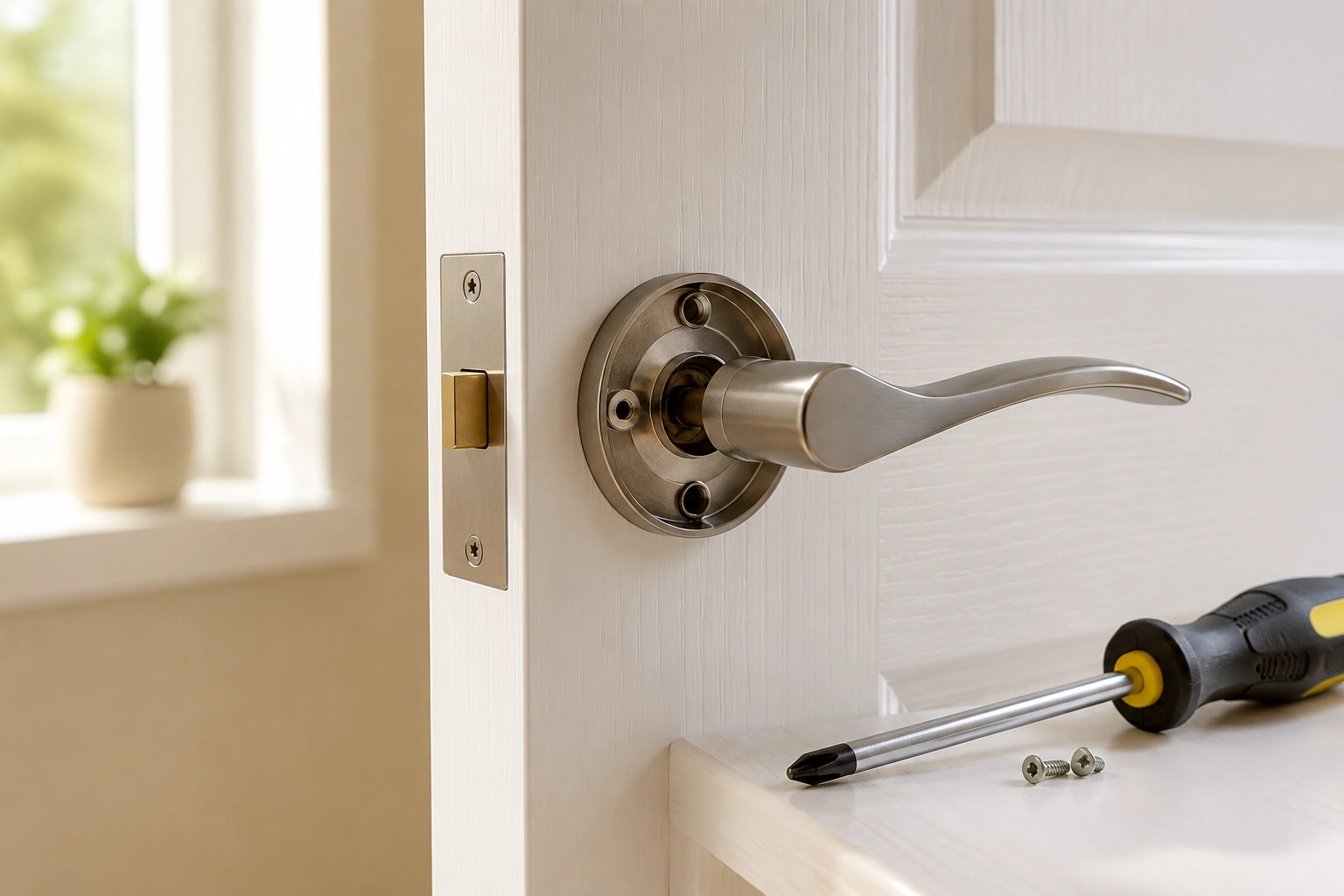
Whether a handle has finally given up after years of use or you are simply ready for an update, changing a door handle is one of the most satisfying small home jobs you can do yourself. It takes around 20 to 30 minutes, needs only a screwdriver, and the results are immediately noticeable.
This guide walks you through the full process so you can get it done confidently, first time.
What you will need
- A flat-head screwdriver
- A Phillips screwdriver
- Your replacement door handle
- A tape measure
- A pencil (optional, for marking)
If you have not yet chosen your new handle, take a look at our full range of door handle sets which include everything you need for a clean, complete swap.
Step 1: Remove the old handle
Start by locating the screws on the rose or backplate behind the handle. On lever handles these are usually visible on the face of the backplate. On some styles there is a small grub screw on the underside of the lever itself. Use a flat-head screwdriver to loosen it, then the lever will pull free.
Once the lever is off, unscrew the backplate or rose from the door face. Keep the screws somewhere safe as you may need them for comparison when fitting the new handle.
Step 2: Check the spindle
The spindle is the square bar that passes through the door and connects both sides of the handle. Pull it out and check its length and size. Most standard internal door handles use a 7 or 8mm square spindle. If yours is worn or bent, now is the right time to replace it.
You can find compatible door handle spindles in our accessories section.
Step 3: Check the latch
Take a moment to check the latch mechanism while the handle is off. Press it in and release it a few times. If it springs back cleanly it is in good order. If it sticks or feels sluggish, this is a good time to replace it before fitting the new handle.
Step 4: Fit the new handle
Slide the new spindle through the latch mechanism from one side of the door. Offer up the first backplate or rose and align it with the existing screw holes. If your new handle has a different backplate size you may need to fill and re-drill, but most standard handles follow the same fixings.
Screw the backplate into position, then attach the lever or knob. Tighten the grub screw if there is one. Repeat on the other side.
Step 5: Test it
Open and close the door a few times, pressing the lever down and releasing it. It should move freely without sticking and the latch should retract and spring back smoothly. If the lever feels stiff, check that the spindle is sitting centrally through the mechanism and not binding against the latch casing.
A note on matching your finish
If you are changing one handle, it is worth thinking about whether the rest of the door furniture on the same door still matches. Escutcheons, hinges and stops all come in the same finish families.
For a classic, warm look, our antique brass door handles pair beautifully with matching escutcheons and hinges. For something more contemporary, black door handles are one of our most popular choices and suit both period and modern interiors.
How do I know if my door handle needs replacing?
The most obvious signs are a handle that wobbles on the backplate, a lever that does not spring back fully, or visible wear to the finish. If the latch is not catching properly it is more likely a latch or strike plate issue than the handle itself, but if the spindle is worn that can cause the same symptom.
A quick rule of thumb: if tightening the screws does not fix the wobble, it is time for a new handle.
Browse door handles
Find your next handle in our full collection of door handles, available in a wide range of finishes and styles for every room in the house.